Georgia GOP House leaders scrap special session redistricting plans
Lawmakers must still address QR voting issues ahead of November elections.
ATLANTA, Ga. (Atlanta News First) — Only minutes before a special legislative session was set to convene to redraw Georgia’s legislative and congressional maps, House GOP leaders announced they will not undertake that effort, at least not for now.
In a letter to Gov. Brian Kemp - who called the special session after the U.S. Supreme Court decision in Louisiana v Callais - Republican House leaders wrote, “Changes to Georgia’s maps should take place only when members of the General Assembly and citizens have been given ample opportunity to gather the facts, provide input and engage in meaningful discussion.
“For this reason, we will not be taking up congressional or legislative redistricting for the 2028 election cycle during this special session,” the letter, signed by House Speaker Jon Burns and other GOP legislative leaders, said.
Why Louisiana v. Callais matters to Georgia
- The Louisiana v. Callais decision weakens Section 2 of the Voting Rights Act, a key law used to challenge discriminatory election maps.
- That means Georgia voters may face higher hurdles to sue over district lines they believe dilute minority voting power.
- The ruling could make it easier for unfair maps to stay in place longer, shaping who can realistically win elections in Georgia.
- It may affect representation not just in Congress, but also in Georgia’s legislature and local governments.
The letter was delivered only hours after Kemp’s two endorsed candidates in Georgia’s primary runoff elections - Lt. Gov. Burt Jones and former football coach Derek Dooley - lost their bids for the GOP gubernatorial and U.S. Senate nominations, respectively.
At a press conference announcing their decision, Burns said the legislature should take a slower, more measured approach to redistricting.
“We believe that it’s important to do things the Georgia way: responsibly, transparently and with ample opportunity for public input,” he said.
>> CLICK HERE FOR LIVE ELECTION RESULTS
Kemp had called the special session after the decision in Louisiana v Callais, a decision that weakened Section 2 of the Voting Rights Act, a key law used to challenge discriminatory election maps.
Kemp said the state would keep the same legislative and congressional maps for the 2026 election, but those maps would need to be changed before the 2028 cycle.
The legislature’s failure to take up the task was a stunning rebuke of the outgoing governor. Kemp also suffered two more electoral blows Tuesday night, when Lt. Governor Burt Jones and Derek Dooley, Kemp’s endorsed picks for Governor and U.S. Senate respectively, lost their runoff elections.
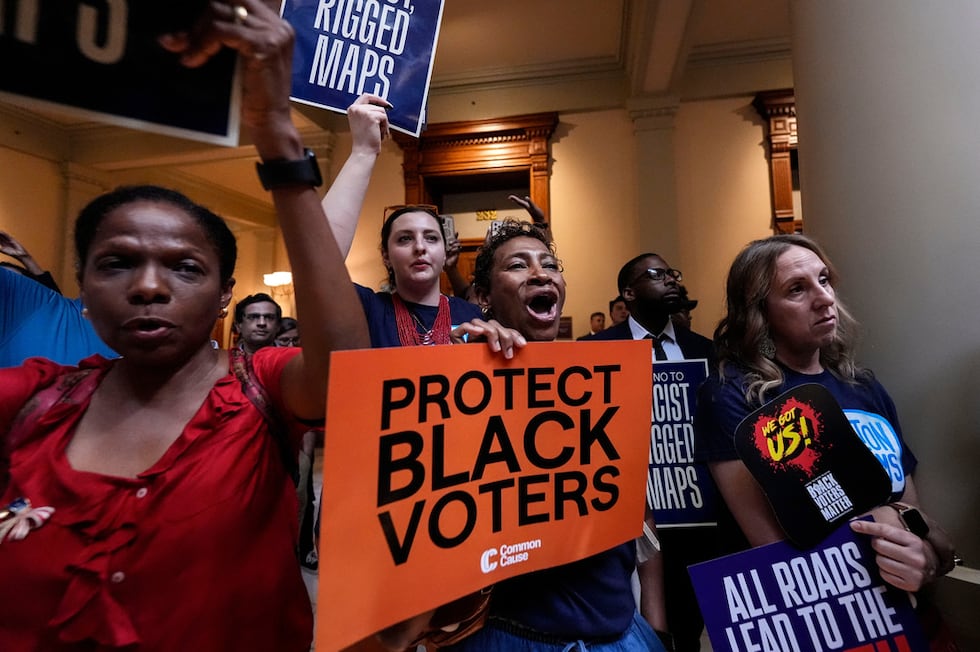
The Capitol was also filled with activist and people in opposition to the redistricting effort. They erupted in applause when Burns announced the effort had fallen flat.
The Callais decision, political experts have said, would disproportionately impact Black voters by diluting their power to vote in unison as a bloc.
“They made a great decision today,” said Joshua Deriso, a voting rights activist and former mayor of Cordele. “Hopefully the decision that was made during this moment is a matter of the heart and not just the mind.”
Others suggested pressure from high ranking lawmakers like Georgia’s U.S. Senator Raphael Warnock - who was at the Capitol decrying gerrymandering on Wednesday - may have caused Republicans to rethink their agenda, rather than rick energizing the Black voting base before a crucial midterm election in November.
“The most high God has literally changed the hearts and the minds so that they go through a process that is fair,” said Rev. Ferrell Malone, the pastor at Macedonia Baptist Church. “They energize us. They energize us to go out when they try to suppress it.”
Despite redistricting being off the map, lawmakers must still address a looming deadline set by the General Assembly to outlaw the current QR-code system of ballot tabulation.
On July 1, per a law passed by the General Assembly in 2024, the QR codes currently used to tabulate Georgia ballots become unlawful. The change reflected deep skepticism about the state’s election in 2020.
- State Elections Board says it does not have authority to pick new voting method
- Lawmakers racing against July deadline to pick new way to vote in Georgia
But in lieu of the soon-to-be illegal QR codes, lawmakers adjourned their session this year without picking a replacement method for tabulating votes. It meant there was no uniform way for counties to legally count their ballots ahead of the November midterm elections.
Kemp also expanded the special session’s agency to include a property tax issue that could soon go before voters.
The added focus centers on a property tax relief measure passed in the final hours of the 2026 legislative session, and a fast-track push to let counties put a new tax question on local ballots as early as Nov. 3.
If lawmakers act during the special session, counties could ask voters whether to add a 1-cent sales tax and use that revenue to reduce county and city property taxes on owner-occupied primary homes.
Kemp’s office said the goal of the special session action is to pass local enabling legislation so counties can plan for implementation and, if they choose, place the question on the ballot this fall.

This story is developing.
Atlanta News First and Atlanta News First+ provide you with the latest news, headlines and insights as Georgia continues its role at the forefront of the nation’s political scene. Download our Atlanta News First app for the latest political news and information.
Copyright 2026 WANF. All rights reserved.